
Pizza Nutrition Facts: Calories, Carbs, Protein & Is Pizza Healthy?
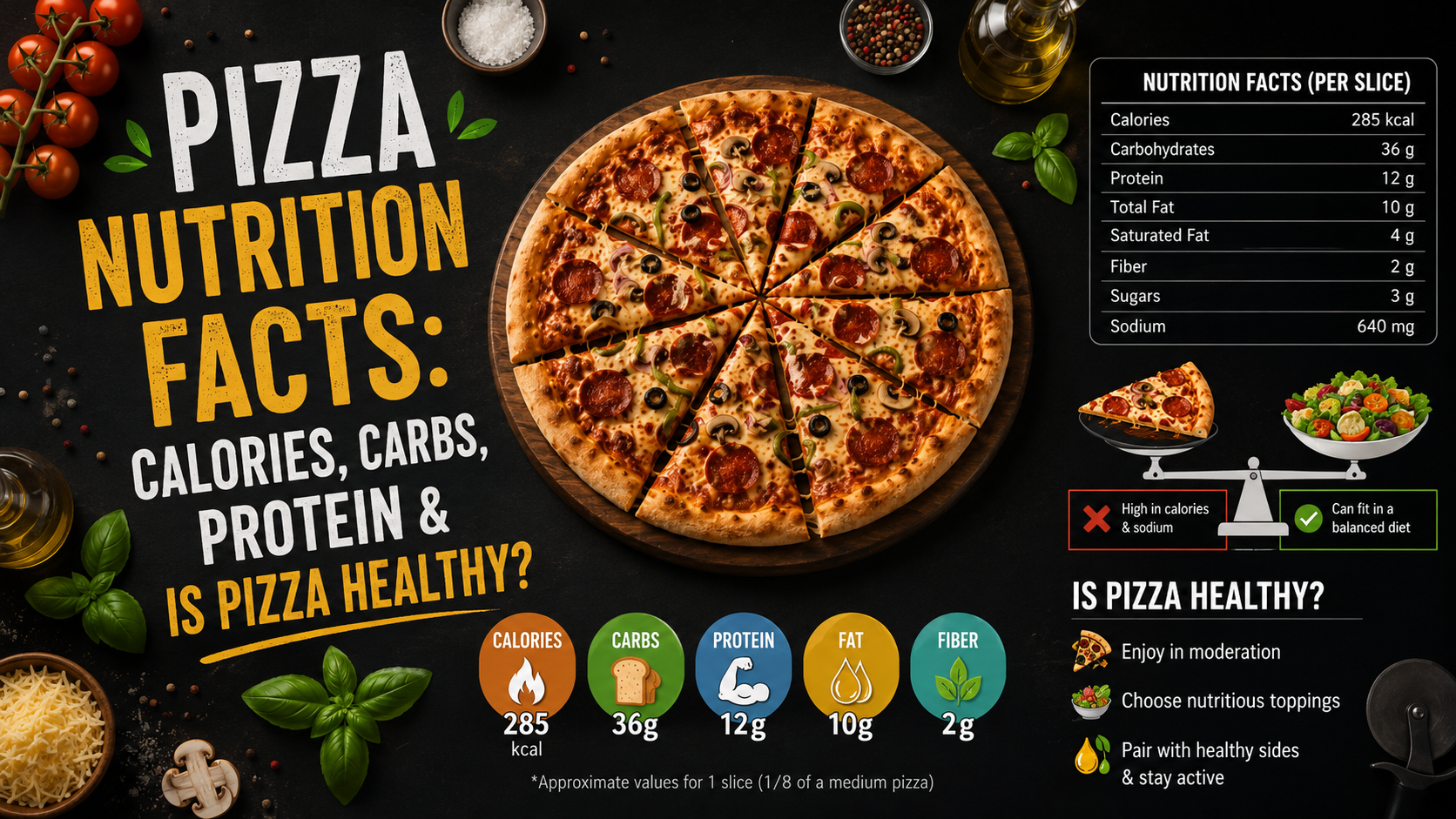
A single slice of standard cheese pizza (about 107g, 1/8 of a 14-inch pie) contains roughly 285 calories, 12g of protein, 35g of carbs, and 11g of fat. That's the short answer. The real answer is more interesting — because crust style, cheese amount, and toppings can push a single slice anywhere from 170 to over 450 calories, and change its carb, protein, and sodium content dramatically.
This guide breaks down the complete nutritional content of pizza — macros, micronutrients, topping-by-topping calorie math, and the honest answer to "is pizza healthy?" and "is pepperoni bad for you?" — using USDA FoodData Central figures and current nutrition research. At the end, use our free Pizza Calorie Calculator to get an exact number for your own slice.
Nutrients in a Slice of Pizza: Full Breakdown
A standard slice of cheese pizza gets its calories from three sources: the dough (carbs), the cheese (fat and protein), and the sauce (mostly negligible calories, but flavor and lycopene). Here's the average macro and micronutrient profile for one slice:
| Nutrient | Amount per slice | % Daily Value* |
|---|---|---|
| Calories | 270–290 kcal | 14% |
| Carbohydrates | 33–36 g | 12% |
| Protein | 11–12 g | 24% |
| Total Fat | 10–11 g | 14% |
| Saturated Fat | 4–5 g | 22% |
| Sodium | 550–650 mg | 25–28% |
| Calcium | 180–200 mg | 15% |
| Vitamin A | small amount | 6–8% |
| Fiber | 2–3 g | 8% |
*Based on a 2,000-calorie daily diet; values vary by brand, crust, and recipe.
Beyond the macros, pizza contributes a few nutrients worth knowing about:
- Calcium — from the mozzarella, supporting bone health. A couple of slices can cover 25–30% of a day's calcium needs.
- Lycopene — an antioxidant from the tomato sauce, linked to heart and prostate health in research on tomato-based foods.
- Sodium — the nutrient to actually watch. Between the crust, cheese, sauce, and cured toppings, two slices can already use up a third of a full day's recommended sodium intake.
- Saturated fat — mostly from the cheese, and the main reason pizza is typically flagged as an "occasional" food rather than a daily staple.
How Many Calories Are in Pizza? (By Type and Chain)
"How many calories in pizza" doesn't have one answer — it depends heavily on crust thickness and toppings. Here's a realistic range per slice (1/8 of a 14-inch pizza):
| Pizza Type | Calories per Slice |
|---|---|
| Thin crust veggie | 170–230 |
| Plain cheese | 250–290 |
| Pepperoni | 290–320 |
| Hand-tossed, one meat topping | 280–310 |
| BBQ chicken | 310–350 |
| Meat lovers / supreme | 380–420 |
| Deep dish cheese | 400–450 |
| Stuffed crust | 350–380 |
By popular chain, per slice of a medium pizza:
| Chain / Style | Calories (cheese, per slice) |
|---|---|
| Pizza Hut Thin 'N Crispy | 180–200 |
| Pizza Hut Hand-Tossed | 230–250 |
| Domino's Hand-Tossed Pepperoni | 290–310 |
| Pizza Hut Original Pan | 270–290 |
| Pizza Hut Stuffed Crust (large) | 350–380 |
| Blaze / Mod (build-your-own, whole pie) | 600–1,200+ depending on toppings |
The build-your-own chains (Blaze, Mod) are the hardest to estimate because every pie is different — a light-cheese veggie build can stay under 600 calories for the whole pizza, while a loaded meat-and-extra-cheese build can top 1,200. For an exact figure on any combination, our Pizza Calorie Calculator lets you enter crust type, size, and toppings and get a precise result instead of guessing from a nutrition PDF.
One more useful data point: most people underestimate pizza calories by 20–40%, and the average adult eats 2.5–3 slices in one sitting — meaning a "normal" pizza meal is often 700–850 calories before any sides or drinks.
Carbs in Pizza: What You Need to Know
Carbohydrates are the largest macronutrient in a standard slice, and they come almost entirely from the crust (refined wheat flour). Here's how carbs in pizza break down by crust style:
| Crust Style | Carbs per Slice |
|---|---|
| Thin & crispy | 24–28 g |
| Hand-tossed / regular | 33–36 g |
| Deep dish | 40–45 g |
| Stuffed crust | 42–48 g |
A useful nuance: thin crust doesn't necessarily cut total calories as much as people expect, because it has less dough but the same cheese and toppings — which makes it slightly more calorie-dense per gram, even though it's genuinely lower in total carbs. If you're managing carb intake specifically (rather than total calories), thin crust is still the better choice. A standard slice's ~35g of carbs also makes traditional pizza incompatible with strict keto or low-carb plans; cauliflower or almond-flour crusts are the workaround if you want the format without the carb load.
Does Pizza Have Protein? Yes — Here's How Much
Pizza does have protein, mostly from the cheese, and more if meat toppings are added. A plain cheese slice delivers 11–12g of protein — comparable to a small egg and a half. Add pepperoni, sausage, or chicken, and a slice can reach 15–18g of protein.
| Topping | Protein Added per Slice |
|---|---|
| Extra cheese | +3–5 g |
| Pepperoni | +4–6 g |
| Italian sausage | +5–7 g |
| Grilled chicken | +6–8 g |
Two slices of a meat-topped pizza can realistically provide 25–30g of protein — a meaningful contribution to daily protein needs, even if it comes bundled with more sodium and saturated fat than a lean protein source would.
Is Pizza Healthy? An Honest Answer
Pizza is neither uniquely healthy nor uniquely unhealthy — it's a calorie-dense, sodium-heavy food that can fit into a balanced diet in moderate amounts. The honest picture:
In pizza's favor:
- Real nutritional value — calcium, protein, and lycopene aren't nothing.
- It's flexible: vegetable toppings, whole-wheat crust, and lighter cheese meaningfully improve the nutrition profile without changing the format.
- Portion control is the main lever, not pizza itself — one or two slices with a side salad is a very different meal from half a pie solo.
Working against it:
- A refined-flour crust plus cheese plus cured meats stacks saturated fat and sodium quickly — two slices can already use up close to a third of a day's sodium.
- It's easy to overeat because it's shared from a whole pie rather than portioned in advance.
- Frequent, large-portion pizza consumption is associated with higher overall calorie and sodium intake in dietary surveys.
The practical takeaway echoed by most dietary guidance: pizza works fine as an occasional meal, especially with vegetable toppings, thinner crust, and portion awareness — the problem is usually frequency and portion size, not the food itself.
Is Pepperoni Healthy? Is Pepperoni Bad for You?
This is where the picture gets more clear-cut. Pepperoni is a processed meat, cured with salt and typically sodium nitrite, then fermented and smoked. That matters because:
- The International Agency for Research on Cancer (IARC), part of the WHO, classifies processed meat as a Group 1 carcinogen — meaning there's solid evidence linking regular consumption to increased colorectal cancer risk. This is a "sufficient evidence" classification, not a claim that any amount is dangerous; risk scales with how much and how often it's eaten.
- Pepperoni is high in sodium and saturated fat — a few slices' worth can meaningfully add to daily sodium intake, which matters most for anyone managing blood pressure or heart health.
- "Uncured" or "no nitrates added" pepperoni typically substitutes celery powder, which naturally converts to nitrite during curing — chemically similar to conventional curing, despite the label.
On the plus side, pepperoni does contribute real nutrients: protein (roughly 5–6g per ounce), vitamin B12, niacin, zinc, and selenium.
So — is pepperoni bad for you? Not in the sense of being dangerous in normal, occasional amounts. But it's not a health food either. The same moderation principle that applies to bacon, hot dogs, and deli meat applies here: fine as an occasional topping, worth limiting as a daily habit, and easy to swap for grilled chicken or vegetables if cancer risk or sodium is a specific concern.
How to Make Pizza Healthier Without Giving It Up
A few swaps meaningfully shift the nutrition profile while keeping it recognizably pizza:
- Choose thin crust — cuts total carbs per slice by roughly 20–25%.
- Ask for light cheese — saves 40–60 calories per slice with minimal taste trade-off.
- Swap pepperoni or sausage for grilled chicken or vegetables — keeps the protein, drops the sodium, saturated fat, and processed-meat exposure.
- Skip the stuffed crust and cheese burst — these add 45–80 calories per slice for crust/cheese that doesn't add much satiety.
- Pre-decide your slice count — logging "two slices" before eating is one of the most effective ways to manage a shared-pie meal, since it's easy to lose count once the pizza is on the table.
- Add a side salad or vegetables — bulks up the meal with fiber and micronutrients without adding much to the calorie total.
Frequently Asked Questions
How many calories are in a slice of pizza? A standard slice of cheese pizza (1/8 of a 14-inch pie) has about 270–290 calories. Pepperoni adds roughly 20–30 calories more; deep dish or stuffed crust slices can reach 380–450 calories.
What is the calorific value of pizza per whole pizza? A whole 14-inch cheese pizza (8 slices) totals roughly 2,150–2,300 calories. A loaded meat-lovers pizza of the same size can exceed 3,000 calories.
How many carbs are in a slice of pizza? Around 33–36g for a standard hand-tossed slice, 24–28g for thin crust, and 40–48g for deep dish or stuffed crust.
Does pizza have protein? Yes — a plain cheese slice has about 11–12g of protein, mostly from the cheese. Meat toppings like chicken, sausage, or pepperoni push a slice to 15–18g of protein.
Is pizza healthy? It can be, in moderation. Pizza offers real calcium, protein, and lycopene, but a standard slice is also high in sodium and saturated fat. One or two slices with vegetables or a side salad is a reasonably balanced meal; a half a pie solo, repeated often, is not.
Is pepperoni healthy, or is pepperoni bad for you? Pepperoni is a processed meat, classified by the WHO's cancer research agency as a Group 1 carcinogen due to its link to colorectal cancer risk with regular consumption. It's also high in sodium and saturated fat. Occasional use is generally considered fine; regular, heavy consumption is the pattern worth limiting.
What's the nutritional content of pizza overall? Per slice: 250–350 calories, 30–36g carbs, 10–15g protein, 10–15g fat, 550–650mg sodium, and roughly 15% of daily calcium needs — with meaningful variation by crust, cheese amount, and toppings.
Want an exact number for your specific slice instead of an average? Our free Pizza Calorie Calculator factors in crust, size, and toppings in seconds. And if you're planning quantities, dough, or party sizing too, check out our companion guide: The Ultimate Pizza Calculator Guide.